


UXDuty V3: Verified Consumer Duty evidence
UXDuty has evolved, and Russell talks us through the four key improvements in V3.


Article Overview
Three years on from the FCA bringing in Consumer Duty, our tool UXDuty moves into its third major iteration.
If you’re an FCA-regulated firm it isn’t enough to just respond to complaints. You have to proactively monitor the outcomes your customers receive, find where they fall short, evidence what you did about it and submit a report to your board at least annually.
Your website and the documents sitting behind it are part of how customers experience those outcomes, and the signal gets harder to pick up as more content is added. Version 3 gives you sharper signals to work from, and every one of them is now verified by a person before it reaches you.
UXDuty overview
UXDuty reads your digital journeys, then judges what it finds against the four Consumer Duty outcomes: products and services, price and value, consumer understanding and consumer support.
Doing this by hand, and keeping a record of what changed, takes days. UXDuty scans multiple pages in minutes and reads the page nobody has opened since 2022. It can also be calibrated to your sector. A few examples of what it looks for:
Claims with no source, date or basis behind them
Warnings and exclusions placed below the benefits they qualify
Fees disclosed after the point a customer commits
Cross references pointing at sections that have been renumbered
Support and complaints routes that lead somewhere closed or unstated
Text obscured by artwork, or a link that relies on colour alone
Here are four of the key improvements that we’ve made:
1. New human verification workflow
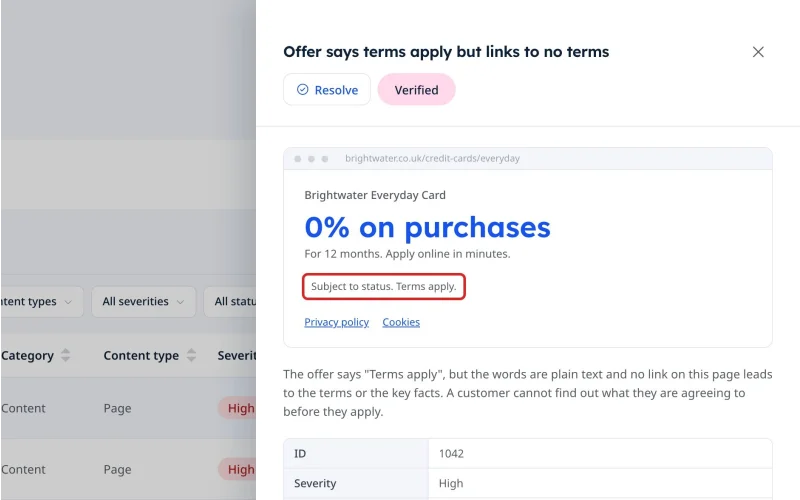
Every finding now has to be verified against the page, or dismissed with a reason, before it can appear in a report. Once something has been fixed on the website, the app checks whether it is still there before the finding is marked as resolved.
That sounds like a step backwards for an automated tool. It isn’t. The model proposes a finding, code checks that proposal against the page’s own text and markup, and anything the page contradicts is removed before anyone sees it.
The effect is a shorter report. It is also a report where every line has been looked at by someone who could be asked about it, which is the difference between a scan and evidence.
2. Merged findings
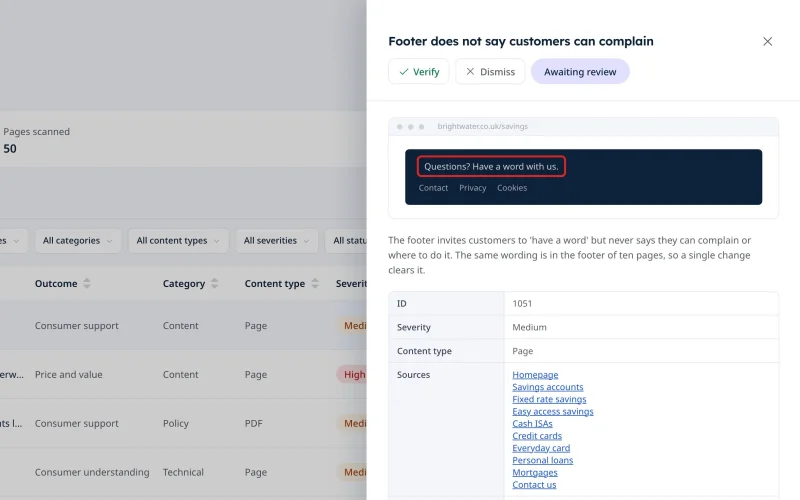
A badly worded footer on ten pages used to produce ten findings. It is one problem with one fix, so it is now one finding with ten sources listed against it.
We don’t merge everything that looks alike. The test is whether a single fix clears it. The same error on a page and in a policy document stays as two findings, because one is a content change and the other is a document reissue, with different owners and different sign-off.
3. Deeper crawling
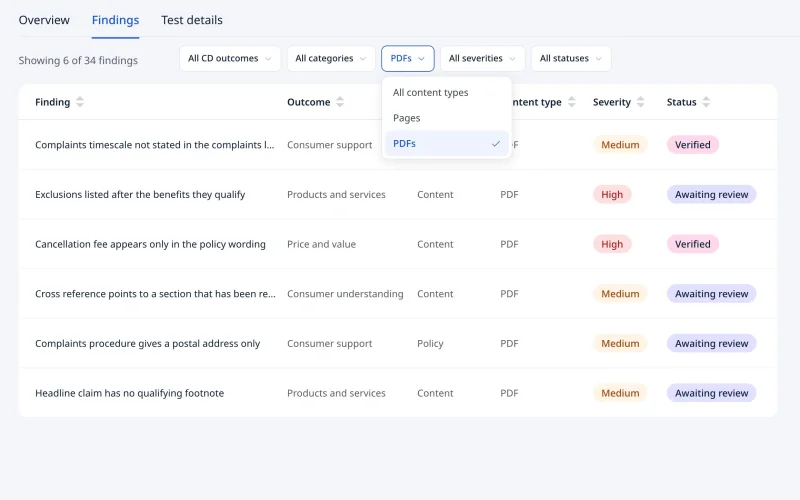
The scanner used to stop at the page it was pointed at. It now follows links down into the product journeys, which is where the claims and the support routes actually live.
It also reads PDFs. Policy wordings, complaints procedures and other key documents carry the same claims as the pages, update on a different cycle and go stale quietly. A page reviewed on its own will tell you half the story.
4. Trends
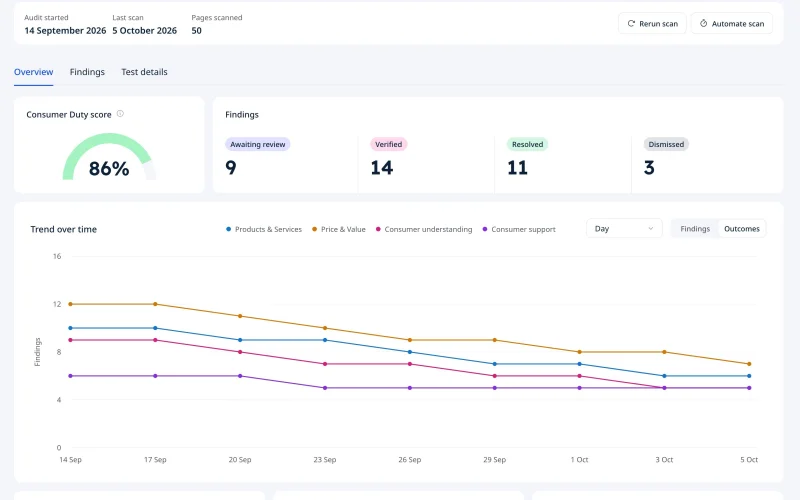
Performance against each outcome, and the number of findings, tracked across audits.
A single audit tells you where you stand today. Run it again after making changes and you can see the trend: what was raised, what has been resolved and whether things are moving in the right direction. That is what shows action is being taken rather than just reported.
Book a demo
There’s more in the release, including a brand refresh and a rebuilt interface. Put all the changes together and the app can now read deeper and report narrower, showing what has changed since the last scan.
Contact us at Indulge to book a demo and have a free audit of your website, or visit uxduty.com for more information.