


How AI Opens the Door for More User Testing
When production is no longer the bottleneck, is the door now open for better user testing?


I have listened closely to our team over the past few months, and the conversation is hard to ignore. AI tools are now good enough at writing deployment-ready code, and production is no longer the bottleneck it once was.
Designers can set direction through wireframes and design systems, then hand these over to a development team while AI does the heavy lifting in between. In some cases, the design team can be bypassed altogether with a well-planned product strategy and strong constraints.
AI makes it easier than ever to ship things that technically work and look impressive, faster than before. As a result, user testing has become the key mitigation step to ensure features and projects resonate with their target audience before launch.
User testing inside an AI production process
For years, many UX teams have argued for a more user-centred production process with unbiased feedback from people outside the project team. In reality, this often breaks down once budgets tighten and delivery pressure kicks in, and the whole process begins to feel like an unnecessary loop. User testing is then positioned as a luxury, reserved for enterprise projects.
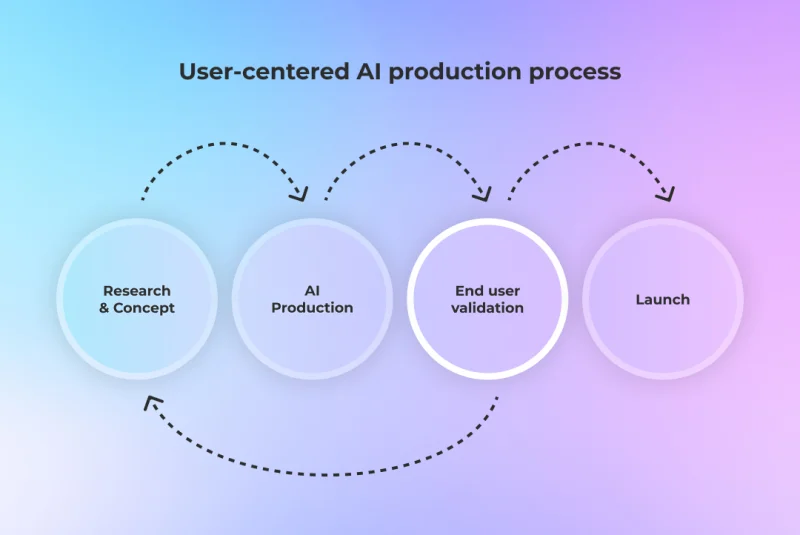
AI weakens that argument, and the ROI calculation flips. When iteration is fast and relatively cheap, there is far less justification for skipping validation. A small amount of testing can prevent a large amount of confidently shipped AI slop.
This makes sense in a few ways:
Much less time spent designing and coding
More budget headroom for user testing of all kinds
More time to invest in user recruitment and screening
Faster iteration without the cost anxiety of extra production sprints
Why not test with synthetic users?
The obvious question is why not just test with synthetic AI users. They are useful for exploration and early stress testing, but they fall down when decisions carry real business consequences.
Synthetic users cannot be independently validated. They miss nuance around trust and understanding, and they struggle with the emotional and contextual responses that influence real behaviour.
User feedback relies on lived experience. We are creating products for humans, not robots. When deciding which features to launch, what to prioritise, or what to cut, you need real people reacting to real things.
Conclusion
User testing is a drum I have been banging for a long time, but now AI has now removed the cost barriers that once made proper testing feel unrealistic.
Imagine a user-centred production process where AI handles execution, with UX experts facilitating real audience validation at each key stage.
As production becomes a commodity churned out using AI, the value of validation rises. And when work is executed autonomously by AI, checking with your users should no longer be optional.