


Data triangulation strengthens your signal
Every source has a bias, and analytics is no longer the trustworthy picture of your audience it used to be. UX teams have been here before. They triangulate rather than trust one source, and now marketing, product and leadership teams need to do the same.


User analytics used to be a trustworthy picture of your audience. Now AI Overviews and AI tools answer questions before anyone clicks, so people can learn about you, compare you and decide on you without visiting your site at all.
The visits you do get are harder to read too. Safari blocks tracking, people decline consent banners and AI agents inflate the numbers. The human engagement data left is skewed towards the people who accept cookies, not your whole audience.
UX teams have been here before
For UX teams, not trusting one source is nothing new. UX researchers have always worked this way, because they've never had one perfect source. As Nielsen Norman Group puts it, "All research methods are limited in some way."
Why one source skews the result
Every source has a bias. Analytics only sees people who arrive. Surveys capture opinion, not behaviour. Complaints come from the loudest customers, not the typical ones. Lean on any one and you inherit its blind spot.
Data triangulation doesn't remove bias. It stops any one bias from making the decision for you. When your sources agree, you act with confidence. When they don't, the gap is often the answer.
Triangulate, don't trust one source
The Encyclopedia of Research Design defines triangulation as "the practice of using multiple sources of data or multiple approaches to analysing data to enhance the credibility of a research study."
The idea comes from navigation and surveying, where you fix your position by taking readings from more than one point. You line up several perspectives to see a clearer picture.
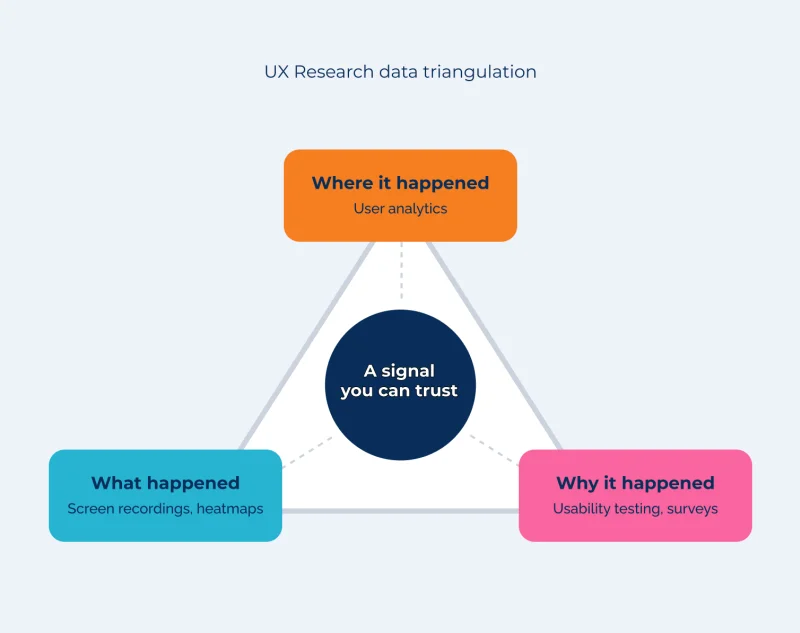
In UX research, analytics can tell you who, what and where. Additional sources tell you why. When analytics shows a page with a 90% bounce rate, usability testing reveals the reason: people see the links but aren't ready to commit.
It works the other way too. When a few vocal customers complain about a feature, the data can show it has a 94% completion rate and nobody is struggling. Triangulation creates design decisions backed by evidence, not hunches.
What it means for other teams
Marketing teams can tell a real drop in audience from a shift to AI search. If visits fall while Search Console impressions rise, people are still finding you, they're just not clicking through.
Product and leadership teams get decisions backed by more than one dashboard, which makes them easier to defend.
Know when to dig deeper
Whatever your role, scale the checking to what's at stake. Tweaking a button label? One good signal will do. Rebuilding a key user journey or tracking campaign performance at scale? Check several sources and where they meet is your answer.