


Design Systems: Central to AI Product Delivery
As AI accelerates interface production, the real challenge shifts to control. Russell breaks down how design systems keep products coherent at scale.


Design systems are becoming more important as AI accelerates interface production. The constraint is no longer how fast teams can build screens but how consistently they can control what is produced. Without a shared system, speed leads to fragmentation and duplicated patterns across products.
A design system is the framework that defines how a product looks, behaves and is built. It provides reusable styles, components and rules that keep design and development aligned as a product scales. It also reduces ambiguity between teams by ensuring interfaces are assembled from shared building blocks rather than designed in isolation.
What a design system is
A design system is made up of several connected elements that work together as a single framework for building products.
It typically includes:
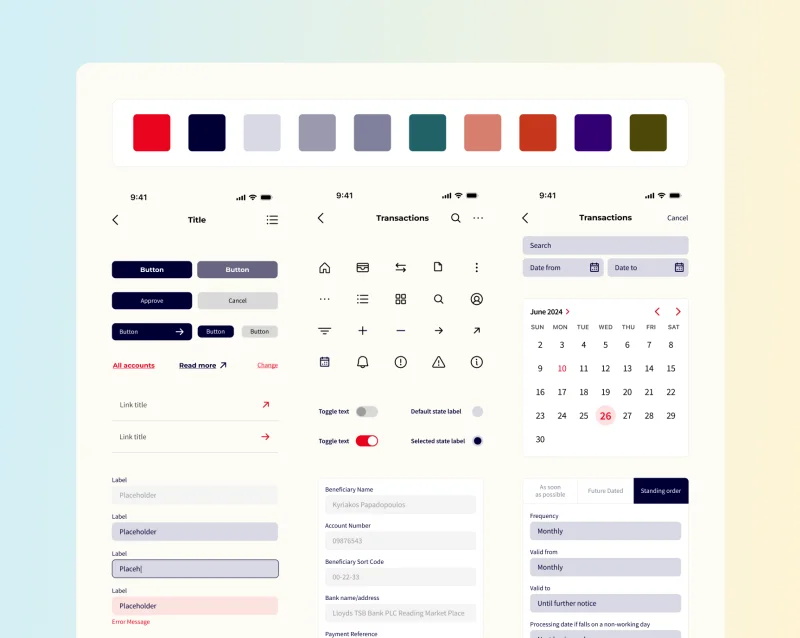
Foundational styles: Colours, typography, spacing and layout rules that define the visual language of the product.
Pattern library: Groups of components combined into common structures such as page layouts, onboarding flows and search experiences.
UI components: Reusable interface elements such as buttons, forms, navigation and cards used consistently across the experience.
Documentation and usage rules: Guidance that defines how components and patterns should be used consistently across design and development teams.
These elements extend brand guidelines into the product itself so that brand expression is reflected across all digital channels.

Building a design system in practice
A design system is built incrementally rather than designed as a complete library from the start. It begins with foundational styles, often derived from existing brand guidelines. Typography should be defined alongside semantic structure so that heading levels and body text map cleanly to HTML elements. From there, attention shifts to high-frequency interface elements such as forms, navigation, buttons and content containers.
These are then standardised into reusable components and grouped into patterns that describe how they function in real contexts such as onboarding flows or page templates. Tools like Figma and Claude can accelerate creation, but the system should ultimately be version-controlled in a shared repository so both design and development can contribute.
Why it matters in production now
AI is increasing the speed at which interfaces can be generated. This shifts the bottleneck from production capacity to control and consistency. Without a system in place, rapid generation leads to inconsistent user experiences and duplicated interface logic.
In financial services this is already visible in internet banking platforms where thousands of account views and forms are generated from shared components rather than individually designed screens. The same applies to public facing journeys where mortgage and savings products rely on reusable grids, templates and consistent page structures.
A design system gives teams a shared structure to work within. Designers define the foundations and patterns while developers maintain and extend them in production. This creates efficiency over time, as reusable components reduce duplicated work and system-level updates can propagate across the entire product.
Where this is going with AI and modular experiences
Product development is moving towards modular systems where interfaces are assembled rather than individually crafted. In this model, AI acts as a generation layer producing layouts and variations at speed, while the design system acts as the control layer that ensures consistency, accessibility and usability.
This creates a shift towards more dynamic, component-driven products where experiences are composed from reusable patterns. The design system becomes the stable foundation that allows AI-generated outputs to remain coherent and production-ready across different contexts.